Paul Klee
222 - Fishes in a Circle
Throughout his artistic career, fish were very special creatures for Paul Klee. The artist was fascinated by their colourful diversity and above all their ability to move freely under water. Along with birds, Klee even included fish in his art theory and the lessons he taught at the Bauhaus. Klee described the “atmosphere”, that means air and water, as related “intermediate realms”. He viewed them as intermediate realms between the earth and space. At the same time, they were intermediate realms because humans can only move within them to a limited extent or using some sort of aid.
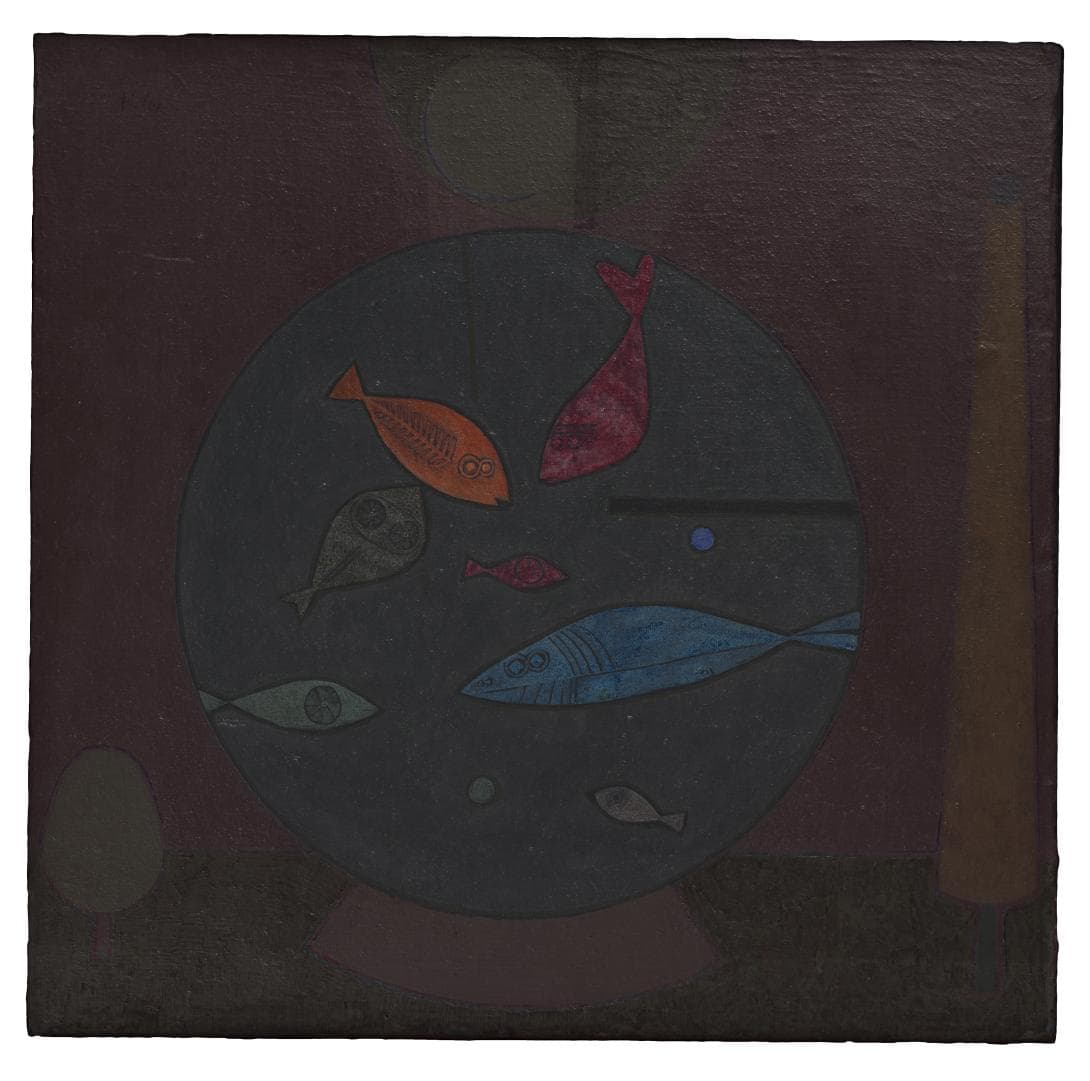
One of Klee’s most beautiful fish paintings was created in 1926: Fishes in a circle. In the centre is a circle with seven fish and two small coloured circles. The fish shine bright in blue, red, orange and green against the dark background. The base transforms the circle into a glass aquarium. This seems to stand in a landscape with one roundish and one elongated tree. Typical of Klee’s animal pictures is his view inside these creatures. In this case, we can see the bones of the fish and other parts of their innards. Klee was convinced that every form is shaped by its interior. In his essay Ways to Study Nature, Klee wrote:
“The object grows beyond its appearance through our knowledge of its inner being, through the knowledge that the thing is more than its outward aspect suggests.”
The skeleton of a human or animal determines its outer shape. In the smaller fish, we can see round shapes; they are reminiscent of eyes and at the same time of wheels with spokes or a mechanism with gears.
Note also the two distinctive black lines in the circle of the aquarium. They actually seem completely out of place. They are simple symbols that represent the vertical and the horizontal in Klee’s work. By including them, the artist was referring to ascent and descent, and to human imprisonment on earth.
Find out more about Paul Klee's collection of shells in our film series "Unpacking Klee".