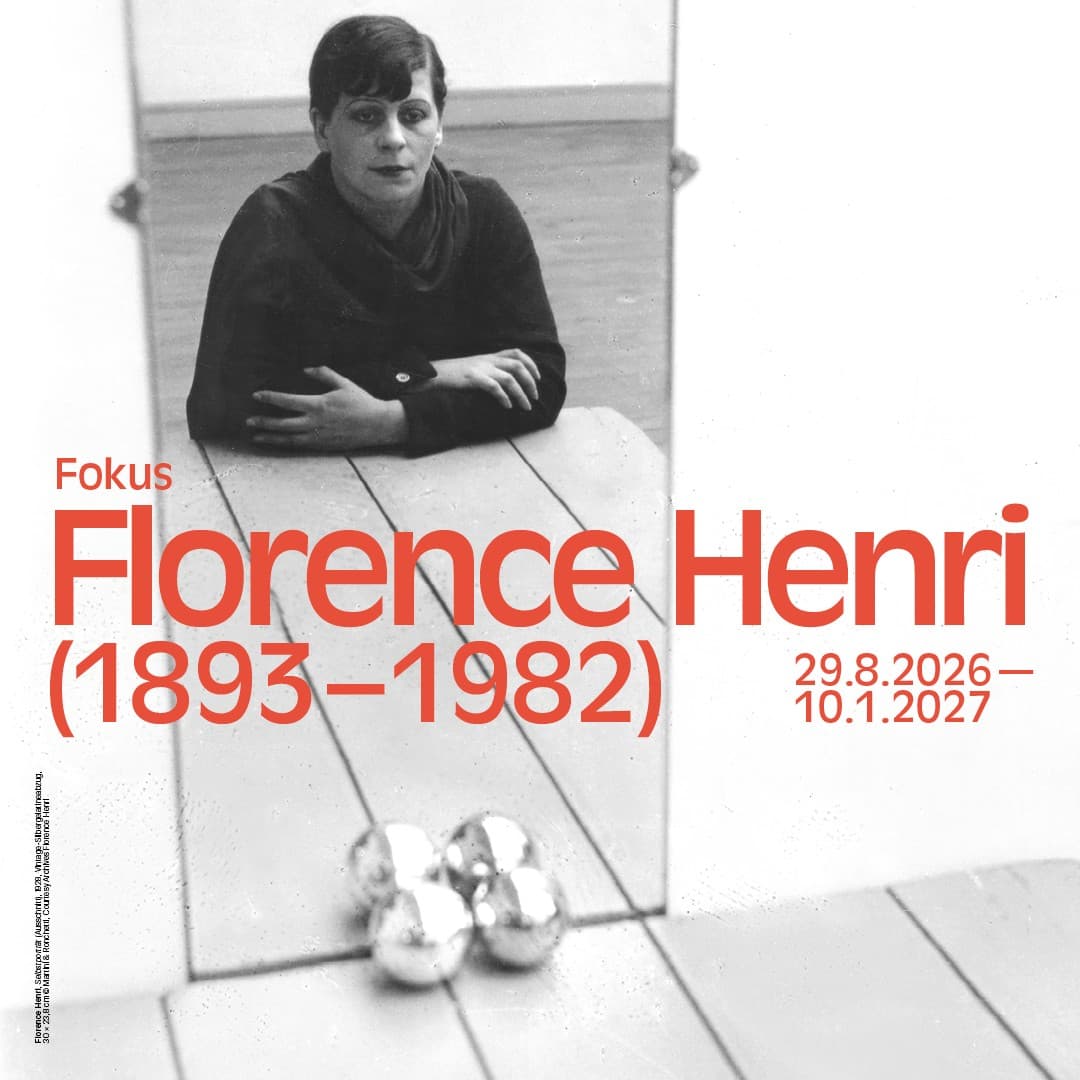
1883 Florence Henri is born in New York to a French father and a German mother.
1895 After her mother’s death Henri becomes a ward of her family in Grünberg, Silesia.
1902 Begins to study piano in Paris.
1905 Lives for three years in England, in London and on the Isle of Wight. She meets Eugène Ysaye and Rafael Kubelík, and studies with Percy Grainger.
1907 After the death of her father in Paris, Henri goes to live with his sister Anni Gori and her husband, the poet Gino Gori, in Rome, where she meets numerous representatives of the artistic and literary avant-garde, including Filippo Tommaso Marinetti, Luigi Russolo, Luciano Folgore and Gabriele D’Annunzio. She studies with Ferruccio Busoni.
1909–1911 Back in London she goes on studying music, and in 1911 plays two concerts of works by Edvard Grieg, Franz Liszt and César Franck in Wigmore Hall in London.
1912–1918 Moves to Berlin, where she continues her music studies. She is a student of Egon Petri and has a relationship with Michael von Zadora. Her house becomes a meeting-point for avant-garde composers and musicians, including Edgar Varese. When, as of 1914, she is no longer able to access her finances in England, she accompanies silent films at the piano in a cinema.
Her self-critical attitude leads her to give up music and turn to painting. She enrols at the Academy of the Arts in Berlin and paints her first figurative works.
1919–1923 She meets the art historian Carl Einstein and the artists Hans Richter, Hans Arp, John Heartfield, Iwan Puni and László Moholy-Nagy. She visits the Weimar Bauhaus and commutes between Berlin and Munich, where she attends lectures by Hans Hofmann. She becomes friends with Theo and Nelly von Doesburg.
1924–1925 Henri marries the Swiss Karl Anton Koster and receives Swiss citizenship. She moves to Paris, where she studies with André Lhote, Fernand Léger and Amédée Ozenfant and becomes friends with Sonia and Robert Delaunay.
1926 She exhibits at the Académie modern in the Galerie d’art contemporain de Paris.
1927 Back in Berlin, she enrols in summer classes at the Bauhaus in Dessau, where she meets up with former acquaintances and meets Paul and Lily Klee, Josef and Anni Albers, Lyonel Feininger, Wassily Kandinsky, Georg Muche, Marcel Breuer, Lucia Moholy, who takes several photographic portraits of Florence Henri, and Walter and Ise Gropius. She has her first experiences in photography.
1928–1929 Her photographic works attract a lot of attention, and she is invited to take part in the most important international exhibitions of experimental photography, including Fotografie der Gegenwart at Museum Folkwang in Essen, as well as the exhibition Film und Foto in Stuttgart.
As a result of the global economic crisis, she loses much of her inheritance. She opens a photographic studio which soon becomes one of the best-known in Paris. She offers photography classes and trains a new generation of photographers, including Gisèle Freund, Lisette Model and Lore Krüger.
1930 Solo exhibition in Studio 28 in Paris, as well as participation at the international exhibition Das Lichtbild in Munich. She produces numerous portraits of women, many of which appear on the front pages of newspapers and magazines.
1931 Her works are included in the exhibitions Foreign Advertising Photography in New York, Die neue Fotografie in the Museum of Decorative Arts in Basel and Photographie d’aujourd’hui in the Galerie La Plume d’or in Paris.
1932 She participates along with Man Ray, Lee Miller, Herbert Bayer and others in the exhibition Modern European Photography in the Julien Levy Gallery in New York and later in the exhibition Modern Movement in Photography at the Royal Photographic Society in London.
In the summer, she travels to Spain and to the islands of Ibiza and Formentera.
1933 On 22 January, a solo exhibition opens in the Kunstverein Folkwang in Essen.
Henri participates in the exhibitions L’image photographique en France de Daguerre à nos jours at the Galerie Braun and Salon du nu, exposition international du nu esthétique at the Galerie de la Renaissance in Paris.
1934 With the closure of the Bauhaus in Dessau many artists leave Germany; some move to Paris. Florence Henri makes portraits of Wassily Kandinsky, Fernand Léger, Hans Arp, Sonia and Robert Delaunay, Iwan Puni and Jacques Villon.
Solo exhibition at the Galerie de la Pléiade followed by participation in the Salon international d’art photographique in Paris.
1936–1945 Henri takes part in the major exhibition Foto 37 at the Stedelijk Museum in Amsterdam
She produces photographic reports which are published in the magazine Lilliput and elsewhere. During these years, changes become apparent in the perspectives, lighting and typology of her photographs.
She returns to painting. The outbreak of war prevents her creative photographic work, so she devotes herself primarily to painting during the war. She makes only two photographic works: In 1940, she carries out a report in Brittany, and in 1942, she makes several portraits of the author Ernst Jünger.
1951–1962 Henri takes long trips to Tossa (1953), Ischia (1954) and Torremolinos (1955), as well as to the island of Mykonos (1956) and the Canaries (1959). She makes numerous paintings inspired by her travels.
1952 Exhibition in the Galerie Nebelung in Düsseldorf. Her photographs from the 1930s are published in various magazines including N-Z Wochenschau.
1953 In Paris, she photographs the famous dancer Rosella Hightower and over the next few years the painter E. W. Nay.
1955 Solo exhibition featuring paintings at the Duisburger Bücherstube.
1963–1970 She leaves Paris and moves to Bellival, where, along with Jeanne Taiffoireau, she restores an old farmhouse and sets up a studio in the building.
1970–1981 She devotes herself to publishing and printing her photographs from old negatives. She makes collages and a final series of abstract works before a severe accident leaves her immobile.
A deeper engagement with her work by numerous art historians leads to many retrospectives of her work being organised, including shows at the Westfälischer Kunstverein Münster, the Staatliche Kunsthalle Baden-Baden, the Musée d’Art Moderne de la Ville de Paris, the Palazzo Pilotta in Parma, at Banco di Chiavari e della Riviera Ligure in Genoa, the Musée national d’art moderne – Centre Georges Pompidou in Paris, the Musée d’art et d’histoire in Geneva and the Musée de Chambéry.
1982 Florence Henri dies on 24 July in Compiègne.