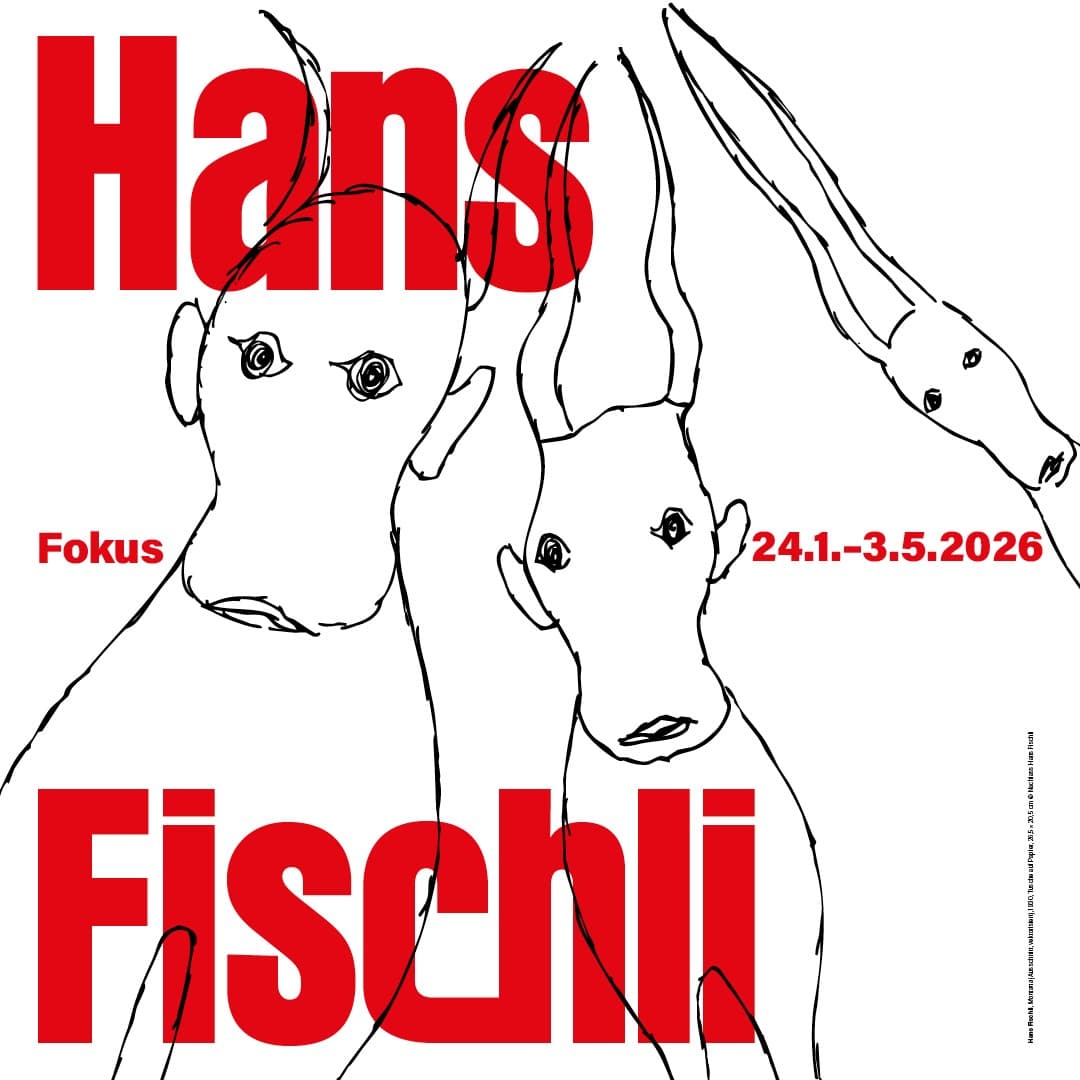
The exhibition Hans Fischli. Zellengebilde focuses on the early works of Hans Fischli (1909–1989) – the artist, architect and student at the Bauhaus. In the shadow of the First World War and the period leading to the rise of National Socialism, Fischli begins creating delicate works on paper at the end of the 1920s – works that bear witness to the modernist movement that is gaining momentum at the time. Shortly after his return from the Bauhaus, where he had studied under Paul Klee, Josef Albers, Wassily Kandinsky and Oskar Schlemmer, the young artist devotes himself almost exclusively to the medium of drawing for several years, alongside his work as an architect.
His simultaneous analysis of the Neues Bauen (New Building) movement and artistic practice in general is crucial for Fischli. In connection with both subjects, he seeks to realise an approach that involves “making as much as possible out of as little as possible.” Klee encourages him to experiment with materials and shows him how to work with signs and symbols. Fischli’s artistic techniques are shaped by both his studies at the Bauhaus and his encounter in Zurich with Otto Meyer-Amden, whose works place the invisible and elusive above the analytical.
“’I’m not here at all to be examined by you; whether you want me or whether you can use me or can’t use me, I don’t want to.’ This led to three months of solitary confinement, which was enormously important for me because I was finally able to do nothing except draw.”
Hans Fischli in an interview, 11 April 1986
In the summer of 1930, Fischli spends three months in the district prison in Meilen for refusing to serve in the military. During this period of isolation, he creates a large group of works: the numbered series Zellengebilde (Cell Formations). These works are the point of departure for this exhibition.
Fischli creates small-scale, filigree-like shapes and organic forms and figures using ink, pencil and sometimes also soft watercolours or coloured pencils. The precision of his strokes and the detailed organisation of the compositions bring to mind natural-science images. Some of his figures imitate human features, while others seem to represent animals, fable characters or plants. The place where these works are created, a prison cell, as well as the artist’s state of mind, lead him to produce a pictorial depiction of life – here in the form of cell division. The dreamlike nature of these fantasy images differs from the concept of constructive modernism, which seeks to present objective, rational principles in an abstract form.
In addition to Fischli’s early visual art, the exhibition presents three selected architectural projects that clearly reflect the turbulent political times of the 1930s and 1940s. One is a project in which Fischli serves as the exhibition architect for the travelling exhibition Kriegsgefangen (Prisoners of War, 1945), which was organised by the International Committee of the Red Cross. In the second project, Fischli uses his interest in education as the basis for the construction of the La Rasa Children’s Village for war orphans near Varese in northern Italy (1949/50). The third project presented involves an early work by Fischli that has received little attention to date: in 1936, Fischli begins designing a combined studio-residential home for his friend and former teacher at the Bauhaus, Oskar Schlemmer.
This exhibition was curated by Fredi Fischli & Niels Olsen, gta Ausstellungen, ETH Zurich.
 Hans Fischli around 1930, Hans Fischli estate