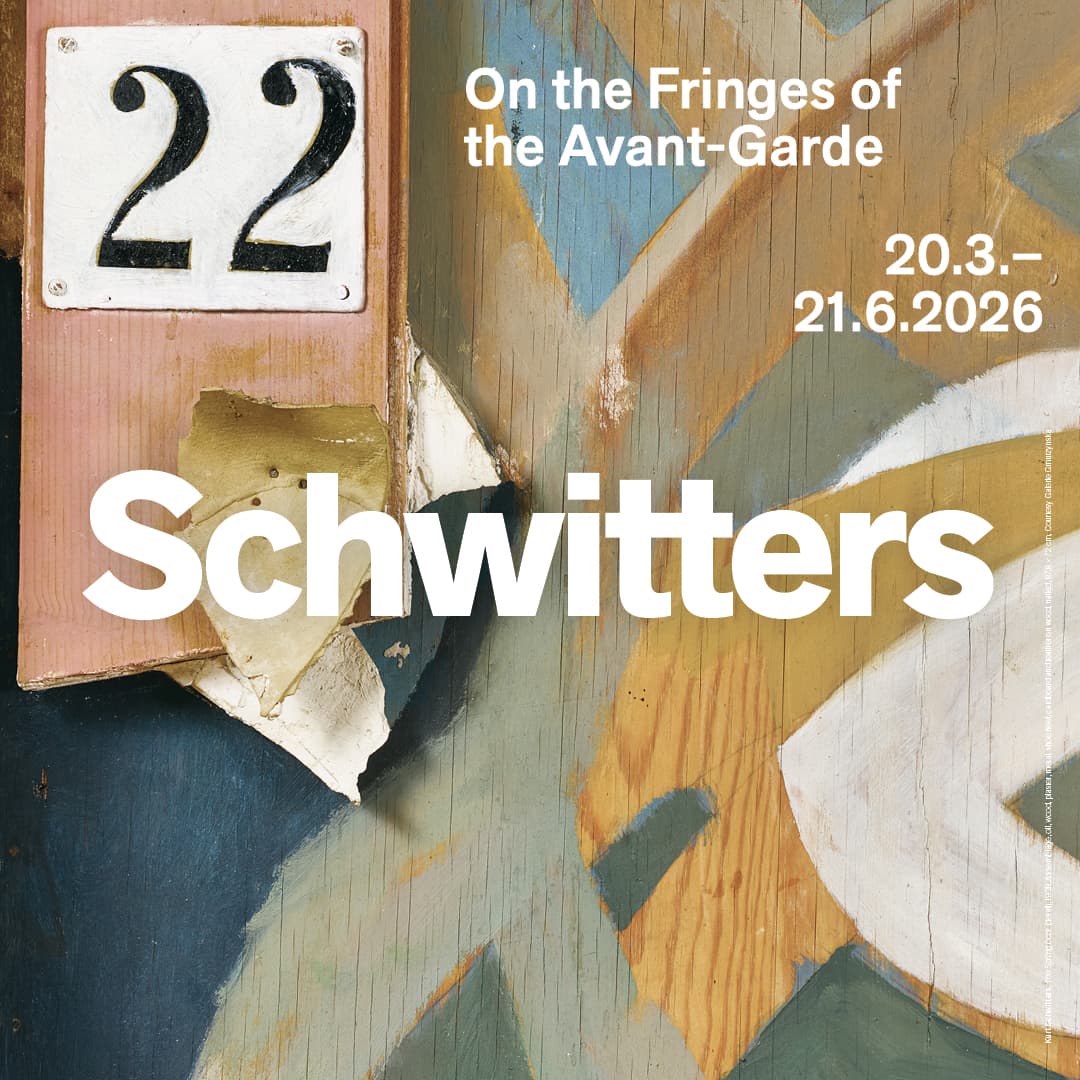
Introduction
Kurt Schwitters (1887–1948) was one of the most prominent figures of the twentieth-century avant-garde, and his work has influenced generations of subsequent artists. Schwitters was an individualist who was known for pushing creative boundaries and who maintained ties to a range of art movements, including Dadaism and constructivism.
Schwitters referred to his working method as “Merz”: he used it to pursue his aim of transforming the everyday into art and creating a harmonious order that could provide a counterpoint to a chaotic and unstable world. In the wake of the First World War, Schwitters came to embody the spirit of freedom and the dawn of a new artistic day from the ruins of the past.
Schwitters’s practice was extraordinarily varied: he worked as a painter, collage and installation artist, illustrator and typographer, magazine editor, writer, poet, and performer. At the centre of his worldview was the principle of collage – the concept of creating art by collecting, combining, and transforming objects, images, and words.
Denounced as a “degenerate artist” by the Nazi regime, Schwitters left Germany in 1937, living in exile in Norway and England. His life in exile was one of isolation and destitution, but he nonetheless persisted with his artistic pursuits. His later work demonstrates an extraordinary artistic resilience and an undiminished passion for experimentation, combining artistic utopia and human tragedy.
Chronology
1887
Kurt Schwitters is born in Hanover as the son of the merchants Eduard and Henriette Schwitters.
1901
Mental illness, first psychogenic seizure.
1908/09
Studies at the School of Arts and Crafts in Hanover.
1909–1915
Studies at the Royal Saxon Academy of Fine Arts in Dresden. Learns academic painting. First expressionist poems.
1911–1913
First participations in exhibitions in Hanover.
1915
Engagement and marriage to Helma Fischer. Sets up a studio in his parents’ house in Hanover.
1916
Birth and early death of their first child, Gerd.
1917/18
Turn towards the expressionist style and development of abstraction. Creation of the Abstractions. Drafted into military service and declared unfit. Compulsory service as a workshop draughtsman at the Wülfel ironworks in Hanover. Exhibitions in Hanover.
1918
First participation in an exhibition at the “Der Sturm” gallery in Berlin. Further regular exhibitions there until 1928. Birth of his son Ernst Schwitters.
1918/19
November Revolution, end of the First World War and end of the German Empire. First collages and assemblages. Schwitters invents the term Merz, which he subsequently uses to unite all his activities under a single designation.
1919
Proclamation of the Weimar Republic. Creation of stamp drawings, watercolours and prints. First contacts with Dadaism. First public presentation of Merz works at the “Der Sturm” gallery.
1920
Contacts with the Berlin Dadaists, Max Ernst, Oskar Schlemmer and Willi Baumeister. First public lectures.
1921
Publication of manifestos and poems in international avant-garde journals in Germany, the Netherlands and Hungary. First solo exhibition at the “Der Sturm” gallery in Berlin. Lecture tour with Hannah Höch and Raoul Hausmann to Prague.
1922
Creation of the first sound poems. Numerous publications. Encounters with El Lissitzky, Hans Arp, Theo and Nelly van Doesburg and Tristan Tzara. First exhibition participation in the Netherlands. Shared studio with László Moholy-Nagy in Berlin. Beginning of his engagement with Constructivism.
1923
Probable beginning of work on the Merzbau in Hanover. Joint trip with Theo and Nelly van Doesburg to the Netherlands. Founding of the Merz magazine and collaboration with Hans Arp, Hannah Höch, Raoul Hausmann and El Lissitzky.
1924
Numerous publications. Founding of the Merz Advertising Office. In the following years increased activity as a designer and typographer.
1926
Travels to Potsdam, Dresden, Rügen, the Netherlands, Prague and Berlin. Participation in the opening of the Bauhaus in Dessau.
1927
Solo exhibition with many stations in Germany. Active lecture schedule and founding of the group die abstrakten hannover. Travels to France, Belgium and Prague. Founding of the ring neue werbegestalter with Robert Michel, Willi Baumeister, Jan Tschichold, Walter Dexel and others.
1929
Work as a typographer for the Hanover city administration (until 1934). Increasing lecture activity as a designer. Membership in the artists’ association Cercle et Carré. First trip to Norway with Helma Schwitters. Participation in the important exhibitions Film und Foto in Stuttgart and Fotografie der Gegenwart in Essen. From 1929 to 1932 annual trips to Paris.
1930
Trip to Basel and Zurich. Probably his last lecture appearance in Germany. From 1930 to 1936 annual summer trips to Norway. Stays primarily at the Hotel Djupvasshytta on Lake Djupvatnet, at the Molde Fjord and on the island of Hjertøya. Earns a living through sales of portraits and landscapes.
1931
Participation in exhibitions on advertising design in Essen and Amsterdam with the ring neue werbegestalter.
1932
Sea voyage with Helma Schwitters through the Mediterranean. Recording of parts of the Ursonate and the poem An Anna Blume for Süddeutscher Rundfunk. Joins the SPD. Lease and beginning of renovation of a hut on the island of Hjertøya in the Molde Fjord.
1933
Nazi seizure of power. Schwitters is defamed by National Socialist cultural policy. Withdrawal from public life. End of exhibition and publication activities in Germany.
1934
Encounter with the futurist Filippo Tommaso Marinetti in Berlin. Trip to Norway.
1935
Trips to Switzerland, Norway and the Netherlands. Visit of Alfred J. Barr Jr., director of the Museum of Modern Art in New York, to Hanover to view the Merzbau, but no personal meeting.
1936
Trips to Paris, Switzerland and the Netherlands. Encounters with Piet Mondrian, Piet Zwart, Edith and Jan Tschichold and Hans and Suzanne Freudenthal. Arrest of the friendly Spengemann family by the Gestapo. Flight of Ernst Schwitters to Norway.
1937
Follows his son Ernst to Norway. Helma Schwitters remains in Hanover but visits Norway occasionally until 1939. Confiscation of works in German museums. Works by Schwitters are shown in the touring exhibition Degenerate Art. Moves to Lysaker near Oslo. Transport of works from his Hanover studio to Lysaker. Summer stays in the Møre og Romsdal region. Landscape paintings and portraits secure their livelihood.
1938
Participation in exhibitions in Oslo and London. Trip to Stockholm, Copenhagen and Gothenburg.
1939
Last meeting with Helma Schwitters.
1940
Invasion of Norway by German troops. Flight with Ernst Schwitters across the Lofoten to Tromsø. Brief detentions. Finally passage to Scotland. Internment in various camps in Scotland and England, then in the Hutchinson Camp in Douglas on the Isle of Man. Sets up a studio. Creates numerous portraits of fellow internees and gives lectures.
1941
Fire in the studio. Release and move to London. Meets Edith Thomas.
1942
Meets Ben Nicholson and Barbara Hepworth. Moves to the London suburb of Barnes together with Ernst Schwitters. Holiday trip to the Lake District.
1943
Creation of small abstract plaster sculptures. Destruction of the Hanover house by an incendiary bomb.
1944
Participation in exhibitions in London and Basel, later a solo exhibition in London. Stroke with temporary paralysis. Death of Helma Schwitters.
1945
Moves with Edith Thomas to Ambleside in the Lake District. Earns a living through portrait, landscape and still-life painting. Travels throughout Great Britain for portrait commissions and to purchase paints.
1946
Illness and illness-related move within Ambleside. Temporary confinement to bed and financial crisis. Final exhibition participations.
1947
Award of a grant by the Museum of Modern Art, New York, for the reconstruction or continuation of the Merz buildings in Hanover or Lysaker. Schwitters uses the funds to work on a new Merzbau in Elterwater.
1948
Granted British citizenship. One day later, death in Kendal in the presence of Edith Thomas and Ernst Schwitters.
Accompanying programme
Aktivitätenheft für Kinder
Zur Ausstellung ist an der Kasse und im Shop ein Aktivitätenheft für Kinder erhältlich.
Collage-Atelier
Gestalten Sie Ihr eigenes Kunstwerk! An interaktiven Stationen in der Ausstellung können Sie aus Plakatentwürfen von Schwitters neue Collagen entstehen lassen.
Typografie Carte Blanche
Studierende der Zürcher Hochschule der Künste (ZHdK, Fachbereich Visual Communication) präsentieren freie typografische Interpretationen von Kurt Schwitters’ legendärem Gedicht An Anna Blume. Die Präsentation ist Teil der Ausstellung.
Ursonate (Live-Performance)
Samstag, 18. April 2026, 14:00
Sonntag, 19. April 2026, 11:00
Fümms bö wö tää zää Uu! Mit dem eigenwillig-epischen Lautgedicht Sonate in Urlauten schuf Schwitters ein poetisches Meisterwerk. Live-Performance durch Michael Schmid (Musiker, Brüssel). Mit Einführung von Martin Waldmeier und anschliessendem Gespräch. Platzzahl begrenzt.
Was bleibt? Über Erhaltung und Zerfall radikaler Kunst
Samstag, 9. Mai 2026
Ein Tag zum Thema Materialität, Vergänglichkeit und den Herausforderungen, die Kurt Schwitters’ Werk heute stellt. Drei Gespräche in der Ausstellung mit eingeladenen Gästen und Martin Waldmeier.
10:30 Merzbau: Rekonstruktion eines verlorenen Gesamtkunstwerks
Der Schweizer Bühnenbildner Peter Bissegger (1932 – 2021) rekonstruierte in den 1980er-Jahren den ikonischen Merzbau von Kurt Schwitters auf Basis von wenigen erhaltenen Fotografien. Wie ging er vor? Weshalb ist der Merzbau so bedeutend? Mit Mario Bissegger (Unternehmer und Designer, Zürich/Intragna)
12:00 Fragile Collagen und die Ethik des Ausstellens
Schwitters hat oft mit weggeworfenen, gefundenen und vergänglichen Materialien gearbeitet. Wie wirkt man dem Zerfall dieser Werke entgegen? Sollte man das überhaupt? Welche Herausforderungen stellen sich beim Ausstellen? Mit Myriam Weber (Papierrestauratorin)
14:00 Die Rettungsaktion der Schwitters-Hütte auf Hjertøya
In den 1930er Jahren arbeitete und lebte Schwitters teilweise einsam in einer Hütte auf der Insel Hjertøya im westlichen Norwegen. Nach jahrzehntelangem Verfall wurde ab 2010 eine grosse Aktion zur Rettung der Hütte durchgeführt. Wie ging man dabei vor? Welche Geschichte erzählt die Hütte heute? Mit Karin Hellandsjø (ehem. Museumsdirektorin, Oslo)
Kunst über Mittag
Dienstags, 12:30 (jede 2. Woche, siehe Website)
Öffentliche Führung
Samstags, 15:00 | Sonntags, 13:30
Visites guidées / Guided tours / Visite guidate
Français : 12.4. / 31.5.2026, 15:00
English: 24.5. / 14.6.2026, 15:00
Italiano: 3.5. / 7.6.2026, 15:00
Einführung für Lehrpersonen
Mittwoch, 25. März 2026, 14:00
Bilderclub
Samstag, 18.4. / 20.6.2026, 11:00 – 12:30
Freundeskreis Zentrum Paul Klee
Donnerstag, 23. April 2026, 18:00
Führung mit dem Kurator Martin Waldmeier und Expert:innen des Hauses. Exklusiv für Mitglieder
Kunst und Religion im Dialog
Sonntag, 26. April 2026, 15:00
Andreas Köhler-Andereggen (Reformierte Kirchen Bern-Jura-Solothurn) im Dialog mit Linus Kessler (Zentrum Paul Klee)
Sinn-Reich
Samstag, 30. Mai 2026, 13:00
Eine alle Sinne ansprechende Führung für Menschen mit und ohne Behinderung. Mit Gebärdensprachdolmetscher:in und induktiver Höranlage
Legal Notice
Digital Guide
Implementation: Netnode AG
Project management: Dominik Imhof
Translations: Gegensatz Translation Collective
The Zentrum Paul Klee is accessible and offers inclusive events.

Publication
To mark the exhibition, Hirmer Verlag is publishing the book Schwitters. Grenzgänger der Avantgarde – Selected Works and Texts, featuring numerous illustrations and a representative selection of 40 short texts by Kurt Schwitters. Available from the museum shop.
In collaboration with the Sprengel Museum Hannover and the Kurt and Ernst Schwitters Foundation, Hannover
With the support of